Why Your Pull Requests and Jira Issues Are Out of Sync (And How AI-Powered Analytics Can Fix It)
PRs and Jira tickets often diverge. Learn why this disconnect happens, the impact on your SDLC, and how Keypup's AI unifies engineering data for accurate insights and optimized workflows.
The Problem: Manual processes and isolated tools cause a critical disconnect between PRs and Jira issues, leading to inaccurate metrics and engineering blind spots.
The Impact: This sync gap results in wasted time, misaligned priorities, skewed DORA metrics, and hinders software delivery performance and value stream management.
Traditional Fixes Fall Short: DIY dashboards and manual reconciliation offer basic visibility but lack the crucial context and prescriptive actions needed to resolve root causes.
AI as the Solution: Keypup's AI engineering analytics platform bridges the Git-to-Jira gap by linking pull requests to issues through the issue keys and references your team already uses, and by surfacing every PR that is left unlinked, so you get contextual, unified insights.
Actionable Intelligence: Keypup's AI Agent provides unsynced Jira PRs solution and generates agile metrics reporting AI instantly from natural language, identifying bottlenecks and driving SDLC optimization AI.
Introduction: Why Your Pull Requests and Jira Issues Are Out of Sync (And How AI-Powered Analytics Can Fix It)
In the dynamic world of software development, engineering teams often operate in two seemingly parallel universes. On one side, product managers, scrum masters, and stakeholders track progress in Jira (or similar project management tools), speaking the language of epics, stories, and sprints. On the other, developers live in GitHub, GitLab, or Bitbucket, immersed in commits, branches, and pull requests.
The critical challenge arises when these two worlds, designed to track the same work, inevitably fall out of sync. A pull request (PR) sits in review, but its corresponding Jira issue is marked "Done." A vital bug fix is merged, but no Jira ticket reflects the effort. This disconnect between Git pull requests and Jira issues isn't just a minor annoyance; it's a fundamental flaw that cripples engineering metrics tracking, obscures developer productivity metrics, and ultimately undermines the entire Software Development Life Cycle (SDLC).
The consequences are severe: misleading DORA metrics, delayed releases, wasted engineering time, and strategic decisions based on incomplete data. Traditional fixes are merely band-aids. But what if there was a way to intelligently bridge this gap, unifying your engineering data with AI-powered insights?
At Keypup, we believe the solution lies in leveraging AI software development analytics to move beyond basic integrations and deliver true SDLC optimization AI.
The Invisible Wall: Why PRs and Jira Issues Diverge
The disconnect between development activity and project tracking isn't a symptom of negligence; it's a systemic problem rooted in the very nature of how these tools and teams operate. Here are the primary culprits creating this invisible wall:
Manual Linking Failures: The most common reason for a broken pull request Jira sync is human error. Developers might forget to link a PR to a Jira issue, mis-link it, or simply create a PR for work that hasn't been formalized in Jira yet (e.g., ad-hoc fixes, refactoring). This leads to a significant portion of development effort becoming "invisible" to project managers.
Tool Silos & Different Languages: Git platforms and Jira are built for different primary purposes. Git is for code collaboration and version control; Jira is for project planning and workflow management. Each has its own lexicon and data model, making native, seamless integration difficult without a unifying layer. Bridging this gap requires more than just a direct link; it requires understanding the context.
Varying Team Workflows: Every team, and even every developer, has slightly different habits. Some might link Jira issues directly in commit messages, others in PR descriptions, and some only after the PR is created. These inconsistencies make automated aggregation a nightmare.
Context Drift and Real-time Discrepancies: Work in progress is fluid. A PR might be opened, reviewed, and merged, but the Jira issue might lag, awaiting a manual status update. Conversely, a Jira issue might be marked "In Review," but the corresponding PR is still being developed. This "context drift" means that at any given moment, the two systems tell different stories, making accurate Jira pull request integration almost impossible without constant manual intervention.
r/ExperiencedDevs
My PM always asks why our Jira sprints don't match our GitHub activity. Dude, I have 5 PRs open and only half of them feel like they relate directly to a single story. It's a nightmare trying to explain the reality.
This fragmentation creates a critical challenge for understanding actual developer productivity metrics and leads to significant engineering blind spots.
The High Cost of Disconnect: Impact on Your SDLC and Business
When your Git and Jira data are out of sync, the consequences ripple throughout your SDLC and directly impact business outcomes. The costs are tangible and often underestimated:
Inaccurate Engineering Metrics Tracking: This is perhaps the most critical impact. DORA metrics (Deployment Frequency, Lead Time for Changes, Mean Time to Recover, Change Failure Rate) become skewed. For instance, if merged PRs aren't linked to Jira issues, your "Lead Time for Changes" will appear shorter than reality, or your "Deployment Frequency" might not reflect the true volume of completed work. Similarly, cycle time analytics become unreliable, failing to capture the full duration from ideation to delivery.
Poor Strategic Decision-Making: Engineering leaders, product owners, and executives rely on data to make informed decisions about resource allocation, roadmap planning, and technical debt prioritization. Fragmented data leads to decisions based on incomplete or incorrect information, resulting in misaligned priorities and suboptimal outcomes.
Wasted Engineering Time: Developers and project managers spend countless hours on manual reconciliation – chasing links, updating statuses, and explaining discrepancies in meetings. This is time pulled away from actual coding, innovation, and strategic thinking.
Delayed Software Releases: Bottlenecks remain hidden. If a PR is stuck in review, but the Jira ticket is progressing, the delay isn't immediately apparent. This lack of clear software development workflow analytics can push back release dates, impacting time-to-market and competitive advantage.
Erosion of Trust and Accountability: When metrics are inconsistent, it fosters a culture of mistrust. Developers feel their work isn't accurately represented, and managers question the true state of projects. This undermines psychological safety and team morale, impacting overall value stream management software effectiveness and true data-driven software development.
Ultimately, this disconnect isn't just an operational headache; it's a barrier to achieving efficient, predictable, and high-quality software delivery.
Traditional Fixes: Band-Aids, Not Cures
Faced with the challenges of a fragmented SDLC, engineering teams often resort to conventional methods to try and bridge the gap. While these approaches might offer a modicum of visibility, they fundamentally fail to address the root causes of the pull request Jira sync problem. They are band-aids, not cures:
Manual Reconciliation via Spreadsheets: The most common (and most dreaded) "solution." Teams export data from Git and Jira, then painstakingly try to match PRs to issues using Excel or Google Sheets. This is incredibly time-consuming, prone to human error, and instantly outdated. It’s a reactive process that only tells you what happened, not why, offering no true SDLC optimization AI.
r/softwaredevelopment
We spend hours in sprint reviews trying to manually 'match' PRs to Jira tickets using some Excel wizardry. It's soul-crushing and completely pointless, pulling us away from actual coding.
Custom Scripts and Integrations: Some teams build their own scripts to pull data from various APIs and attempt to link them. While more automated than spreadsheets, these scripts are notoriously fragile, requiring constant maintenance as APIs change. They also tend to support a single linking convention and provide no contextual insights, failing to deliver a comprehensive unsynced Jira PRs solution.
Standard BI Dashboards: Tools like Tableau, Power BI, or custom-built dashboards can visualize raw data from Git and Jira. However, they are limited by the quality and completeness of the underlying data. If a PR isn't explicitly linked, a BI dashboard won't magically connect it. They provide surface-level metrics without the deep contextual understanding or prescriptive analytics needed to drive meaningful change. They show "what," but rarely "why" or "how to fix."
These traditional methods fall short because they operate on a fundamental assumption: that all relevant data is explicitly linked and clean. In the messy reality of software development, this is rarely the case. What's needed is a system that connects data across every linking convention your teams use, shows clearly what remains unlinked, and provides actionable insights from diverse, often incomplete, engineering data.
The AI Revolution: Unifying Git and Jira with Engineering Intelligence
This is where Keypup's transformative AI software development analytics platform steps in, revolutionizing how engineering teams manage and understand their workflow. We move beyond simple data aggregation to a true engineering intelligence platform that bridges the Git-to-Jira gap and makes every remaining gap visible.
How does Keypup's AI achieve this unification?
Reliable Linking Across Every Convention: Keypup links a pull request to its issues wherever your developers reference them: an issue key such as PROJ-123 in the PR title or branch name, a reference with a closing keyword (such as "Fixes PROJ-123") in the PR description, or an issue key in commit messages. Whatever habits each team has, the links are picked up automatically, and cross-entity fields such as the resolved issues of a PR or the resolving pull requests of an issue become available for reporting, providing a comprehensive software development workflow analytics view.
Unified Data Bridging: Keypup continuously ingests data from all your connected tools: GitHub, GitLab, Bitbucket and Azure DevOps on the code side, and Jira, Azure DevOps Boards, ClickUp, Trello and GitHub Projects on the work side. This creates a unified, single source of truth for your SDLC.
Making Unlinked Work Visible: Because links are explicit, the gaps are measurable. A pull request with no resolved issues is unlinked work, and an issue's Resolution State shows whether any pull request has implemented it yet. Keypup lets you list unlinked PRs, track the linking rate per team, and detect work that sits outside the current sprint, providing real depth to your DevOps analytics platform. You can also record your team's linking conventions in the AI Instructions of your team settings, so the AI Agent follows them when it builds your insights.
Real-time, Actionable Insights: With Keypup, you're not looking at stale dashboards. The AI Agent builds insights and whole dashboards from a question in plain English, and its Analyze button comments on the results with actionable recommendations that drive SDLC optimization AI. You can also ask "which PRs are unlinked?" from Claude, ChatGPT or Cursor through Keypup's read-only MCP server.
By bringing together disparate data sources and making both the links and the gaps visible, Keypup empowers teams to finally see the full picture of their software development efforts, transforming raw data into true engineering intelligence.
AI in Action: Prescriptive Analytics for a Seamless Workflow
Keypup's AI Agent isn't just about showing you data; it's about providing prescriptive analytics – telling you what to do and where to focus your efforts. By simply asking questions in plain English, engineering leaders and developers can gain immediate, actionable insights and resolve long-standing issues related to the Git-Jira disconnect.
Here are examples of how Keypup's AI generates powerful dashboards to solve common problems:
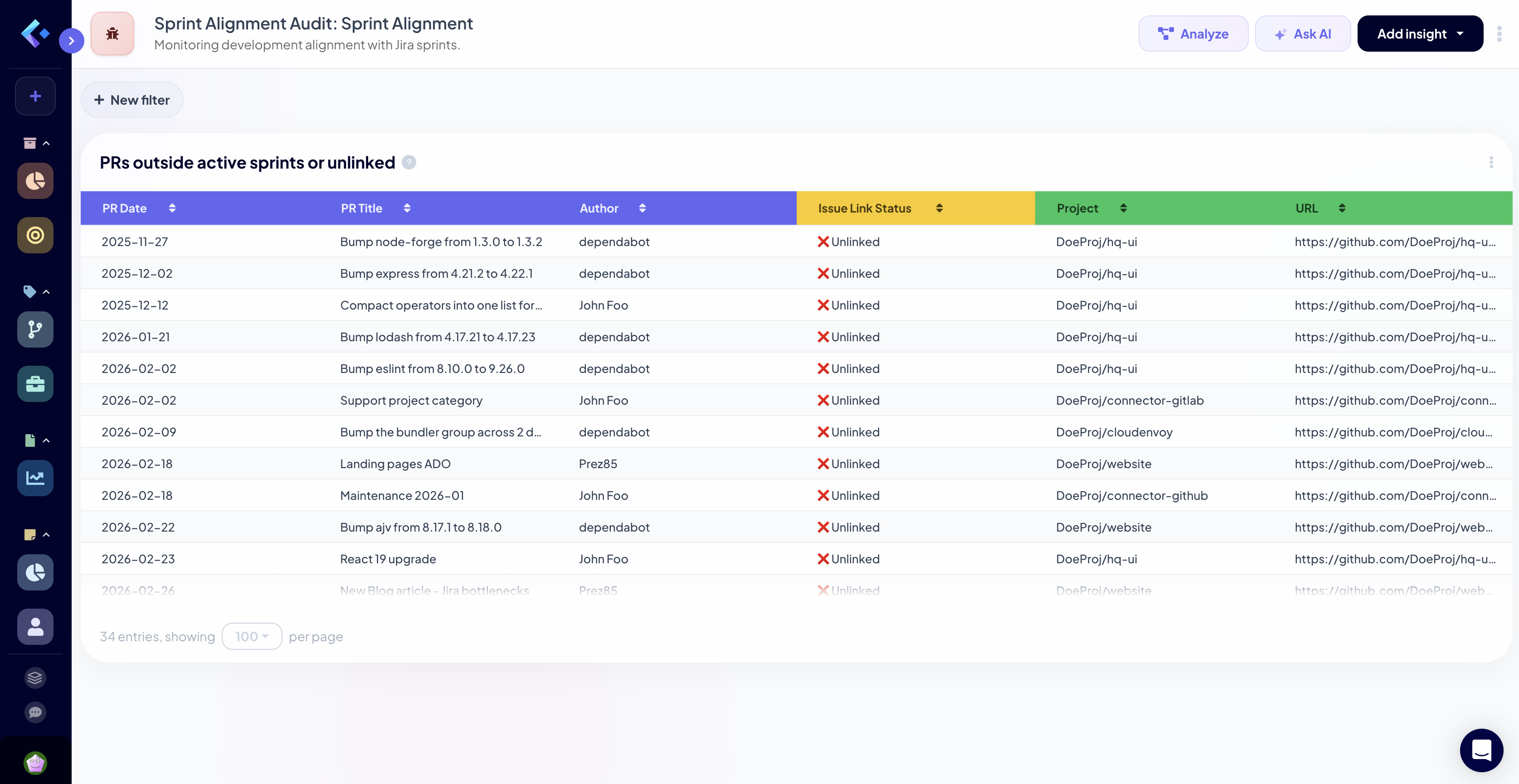
Unlinked PRs Impacting Active Sprints
Prompt to the Keypup platform
Show me all active pull requests that are either unlinked to a Jira issue or linked to a Jira issue not currently in an active sprint.
Context: This dashboard solves the problem of 'invisible work' – development efforts that aren't properly attributed to a Jira issue or sprint. This leads to inaccurate sprint velocity, skewed agile metrics reporting AI, and potential scope creep. It provides a direct unsynced Jira PRs solution by surfacing disconnected work.
Analysis from Keypup AI
Key Insights 📊
Team Alpha has 12 active PRs (total 50 days old) unlinked to any Jira issue.
Team Beta has 8 active PRs (total 35 days old) linked to Jira issues not in the current sprint.
The oldest unlinked PR for Team Alpha is 15 days old, titled "Improve caching mechanism."
⚠️ Bottlenecks and Problem Areas
Process Adherence: Team Alpha shows a significant number of PRs created without corresponding Jira issues, indicating a breakdown in the initial planning or linking process. This skews their developer productivity metrics.
Scope Drift: Team Beta's situation suggests work is being done that might not align with current sprint goals, potentially pulling resources from planned tasks and impacting agile metrics reporting AI.
Stale Work: Old unlinked PRs risk becoming abandoned or requiring significant re-contextualization later, increasing technical debt.
💡 Recommendations
Team Alpha: Implement a stricter PR creation policy requiring a linked Jira issue or a clear explanation for its absence. Provide training on proper Jira pull request integration.
Team Beta: Review sprint planning and mid-sprint scope changes. Ensure all work aligns with current sprint goals, or formalize unplanned work through a defined process.
General: Agree on one linking convention (for example, the Jira key in the branch name) and record it in your team's AI Instructions in Keypup so every dashboard the AI Agent builds applies it.
🚀 Priority Actions
Immediate: Review the oldest unlinked PRs (Team Alpha) to assess their status and either link them, close them, or create new Jira issues.
Short-term: Schedule a review with Team Alpha and Beta leads to discuss and reinforce proper linking workflows.
Long-term: Keep a Keypup dashboard of PRs still unlinked 24 hours after creation and review it in each stand-up, or query them on demand through the MCP server or the API, driving continuous SDLC optimization AI.
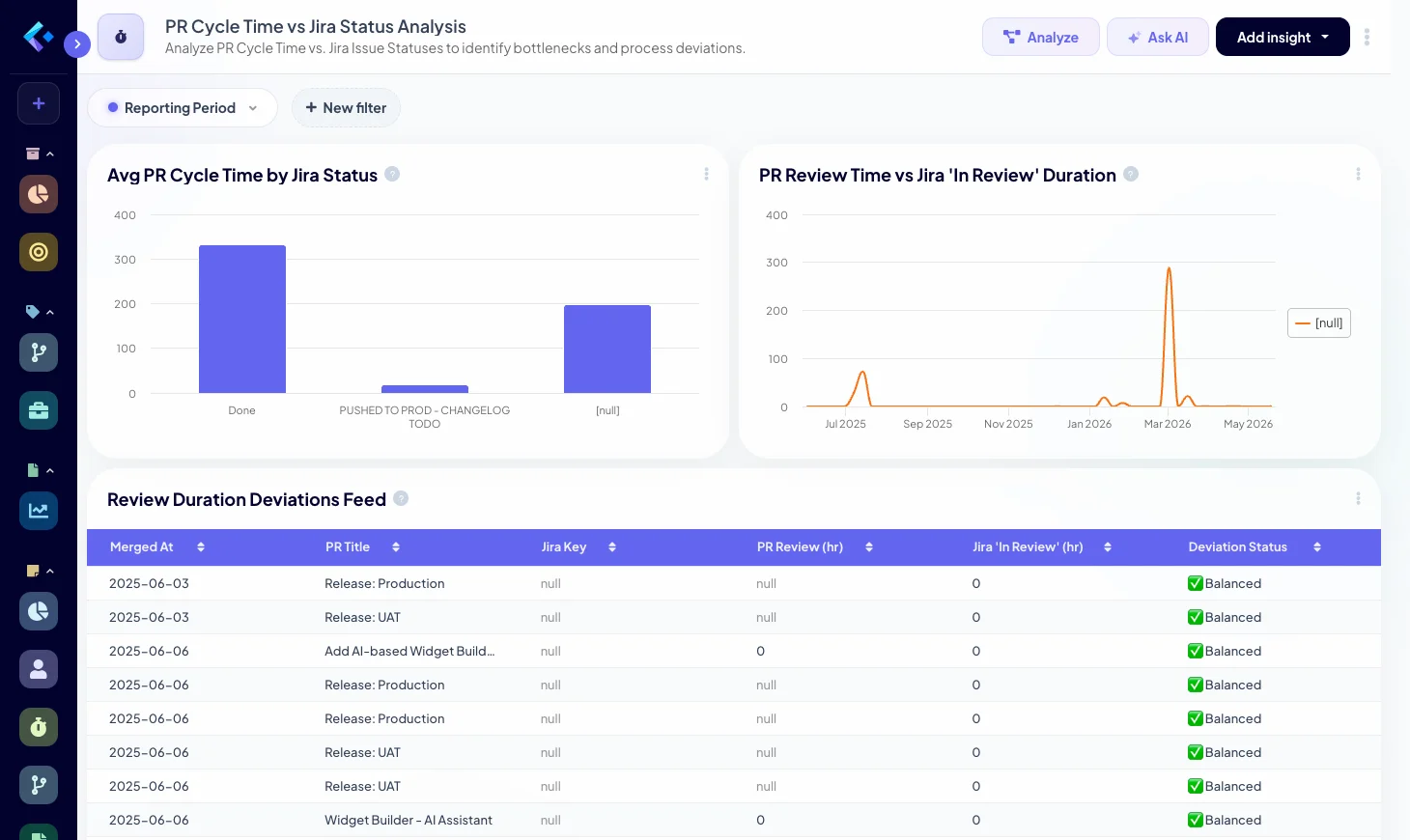
Cycle Time Discrepancies by Jira Status
Prompt to the Keypup platform
Create a dashboard showing the average Cycle Time for pull requests, segmented by the corresponding Jira issue's status (e.g., 'In Progress', 'In Review', 'Done'). Highlight where the PR's 'time in review' significantly deviates from the Jira issue's 'In Review' status duration.
Context: This helps understand how pull request Jira sync issues impact overall delivery speed. It reveals where work might be 'stuck' in the Git workflow (e.g., a PR waiting for review) even if the Jira issue seems to be progressing, or vice-versa. This is critical for accurate cycle time analytics and targeted SDLC optimization AI, providing better software development workflow analytics.
Analysis from Keypup AI
Key Insights 📊
Average PR review time across all teams is 2.5 days.
Jira issues often spend only 0.5 days in 'In Review' status before moving to 'Done', indicating a significant disconnect.
15% of recently merged PRs had a 'time in review' exceeding the Jira 'In Review' duration by more than 3 days.
⚠️ Bottlenecks and Problem Areas
Review Bottleneck: PRs are clearly spending much longer in review than their corresponding Jira issues suggest. This indicates a potential bottleneck in the code review process, not accurately reflected in engineering metrics tracking.
Premature Jira Updates: Jira issues are being marked 'Done' or progressing to the next stage before the actual development work (PR merge) is complete, skewing cycle time analytics. This can hide critical delays and inflate apparent velocity.
Feedback Loop Issue: Delays in PR review directly impact overall software development workflow analytics, potentially frustrating developers and slowing down subsequent tasks.
💡 Recommendations
Standardize Status Definitions: Clarify team-wide definitions for Jira statuses like "In Review" and "Done" to ensure alignment with Git workflow stages.
Automate Jira Status Updates: Use Jira's own automation rules to update issue statuses based on PR events (e.g., "In Review" when PR is opened, "Done" when merged), and use Keypup to measure whether the gap closes, for a better pull request Jira sync.
Improve Code Review Efficiency: Investigate the reasons for prolonged PR review times. Are there enough reviewers? Is feedback timely? Consider implementing pair programming or dedicated review slots to improve code review metrics AI.
🚀 Priority Actions
Immediate: Focus on PRs with the largest discrepancies; manually investigate their history to understand specific blockers and resolve them.
Short-term: Update team conventions for Jira status updates, emphasizing synchronization with actual Git events.
Long-term: Build a Keypup dashboard listing PRs exceeding a defined review time threshold and check it daily, allowing proactive intervention and continuous SDLC optimization AI.
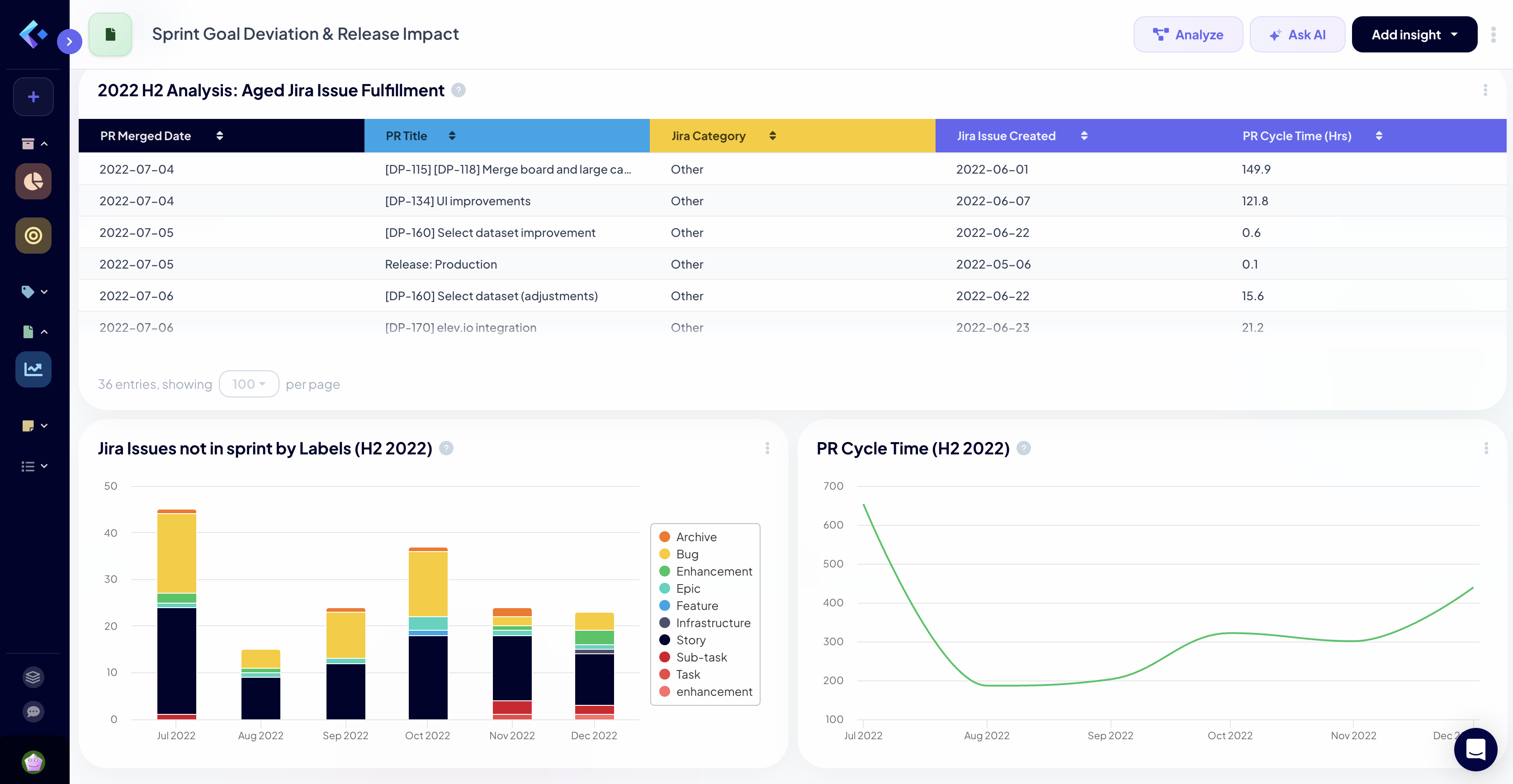
Unplanned Work & Sprint Goal Deviation
Prompt to the Keypup platform
Show me all merged pull requests in the last two sprints that were linked to Jira issues not originally part of those sprints' planned scope. Categorize by Jira issue type (Bug, Refactor, Ad-hoc Task) and show their total impact on estimated story points.
Context: This dashboard addresses the challenge of unplanned work (bugs, immediate fixes) that often isn't properly tracked or accounted for in sprint planning. This leads to a disconnect between actual engineering effort and stated project goals, impacting accurate engineering metrics tracking and overall value stream management software effectiveness.
Analysis from Keypup AI
Key Insights 📊
Total Unplanned Work: 30% of merged PRs in the last two sprints were linked to issues not originally in the sprint plan, accounting for an estimated 45 story points.
Categories: Bugs comprised 60% of unplanned work, Refactors 25%, and Ad-hoc tasks 15%.
Impact: This unplanned work significantly impacted the team's ability to complete planned sprint goals, leading to an average of 15% carryover.
⚠️ Bottlenecks and Problem Areas
Sprint Scope Creep: A high volume of unplanned work indicates difficulty in protecting sprint scope or effectively handling new, urgent requests. This directly impacts value stream management software effectiveness.
Technical Debt Management: A significant portion of unplanned work being "Refactors" suggests underlying technical debt is being addressed reactively, rather than proactively.
Estimation Inaccuracies: The consistent deviation from planned scope indicates that initial sprint estimations might not be realistic, or that buffers for unexpected work are insufficient.
💡 Recommendations
Improved Backlog Grooming: Prioritize addressing technical debt and recurring bug types during backlog grooming sessions to prevent reactive work during sprints.
Dedicated Bug/Emergency Capacity: Allocate a small, fixed capacity (e.g., 10-15% of sprint capacity) for unplanned bug fixes or immediate requests, making it part of the planned scope.
Post-Mortem for Unplanned Work: Conduct brief retrospectives on significant unplanned work to understand its root cause and identify preventative measures. This aids data-driven software development.
🚀 Priority Actions
Immediate: Analyze the specific bug types contributing most to unplanned work; identify if quick wins or process changes can reduce their recurrence.
Short-term: Integrate a dedicated "unplanned work" lane or capacity into the next sprint planning cycle.
Long-term: Use Keypup's AI to track trends in unplanned work by type and team, providing insights for long-term SDLC optimization AI and improved estimation models.
Frequently Asked Questions (FAQ)
Q: Why can't I just use a Jira integration with GitHub?
A: Basic integrations primarily display links inside each tool; they don't measure how much work is unlinked, how long linked issues and PRs take, or where they diverge. They also don't provide the prescriptive analytics needed to proactively solve pull request Jira sync issues or improve workflows. Keypup combines the links found in PR titles, branch names, descriptions and commit messages with analytics across both tools, and its AI Agent builds the dashboards and comments on the results.
Q: How does Keypup's AI handle legacy or messy data?
A: Keypup imports your history from each connected platform and detects issue references wherever your teams put them (PR title, branch name, PR description with closing keywords, or commit messages), so varying conventions across teams are covered. Work that carries no reference at all stays unlinked, and Keypup shows it to you instead of guessing, providing a robust Jira pull request integration solution. This means less time cleaning data and more time acting on insights.
Q: Will this lead to more micromanagement of my developers?
A: Absolutely not. Keypup's approach explicitly shifts the focus from individual performance to systemic bottlenecks within the SDLC. The goal is to foster team-level SDLC optimization AI and continuous improvement, rather than individual surveillance, by providing contextual developer productivity metrics. Our focus is on improving the system, not monitoring individuals.
Q: Is this only for large enterprises, or can smaller teams benefit?
A: Any team struggling with manual reconciliation and fragmented data can significantly benefit. While the value scales with team size and complexity, even small teams gain substantial efficiency by transforming their engineering metrics tracking with Keypup's engineering intelligence platform. The pain of disconnect exists at every scale.
Q: How accurate is the AI in linking PRs and Jira issues?
A: Linking is deterministic rather than inferred: a PR is linked to an issue when the issue key or reference appears in its title, branch name, description (with a closing keyword) or commit messages. Links are therefore as accurate as your references, and a PR without a reference is reported as unlinked instead of being guessed, delivering reliable AI software development analytics. The AI part is the AI Agent, which builds and analyzes the dashboards on top of this data.
Ready to Transform Your Analytics?
Join teams already using AI to make data-driven decisions faster than
ever.
Your median cycle time looks healthy, yet every release still ends in merge conflicts, rebases and big-bang reviews. Learn what engineering leaders on Reddit say about long-lived branches and the trunk-based vs GitFlow debate at enterprise scale, and how Keypup MCP uses pull request dates, target branches, commits, reviews and mergeability to measure branch lifetime, find where branches live longest and land aging work before it drifts into conflict.
Compare the 6 best engineering metrics tools for multi-team benchmarking in 2026 — Keypup, LinearB, Swarmia, Jellyfish, Faros and Appfire Flow — on cross-team benchmarking, org-level rollups, DORA Metrics, Git-to-ticketing linking, custom KPIs, AI capabilities and data security. See how to compare teams on equal terms and find where your delivery process is broken.
In large engineering organizations, thousands of pull requests are closed without merging or left to go stale every year, and nobody measures the cost. Learn what engineering leaders on Reddit say about abandoned pull requests, and how Keypup MCP uses pull request state, review, size, mergeability and Jira link data to size the PR graveyard, find where work dies, and triage stale pull requests before they are lost.